
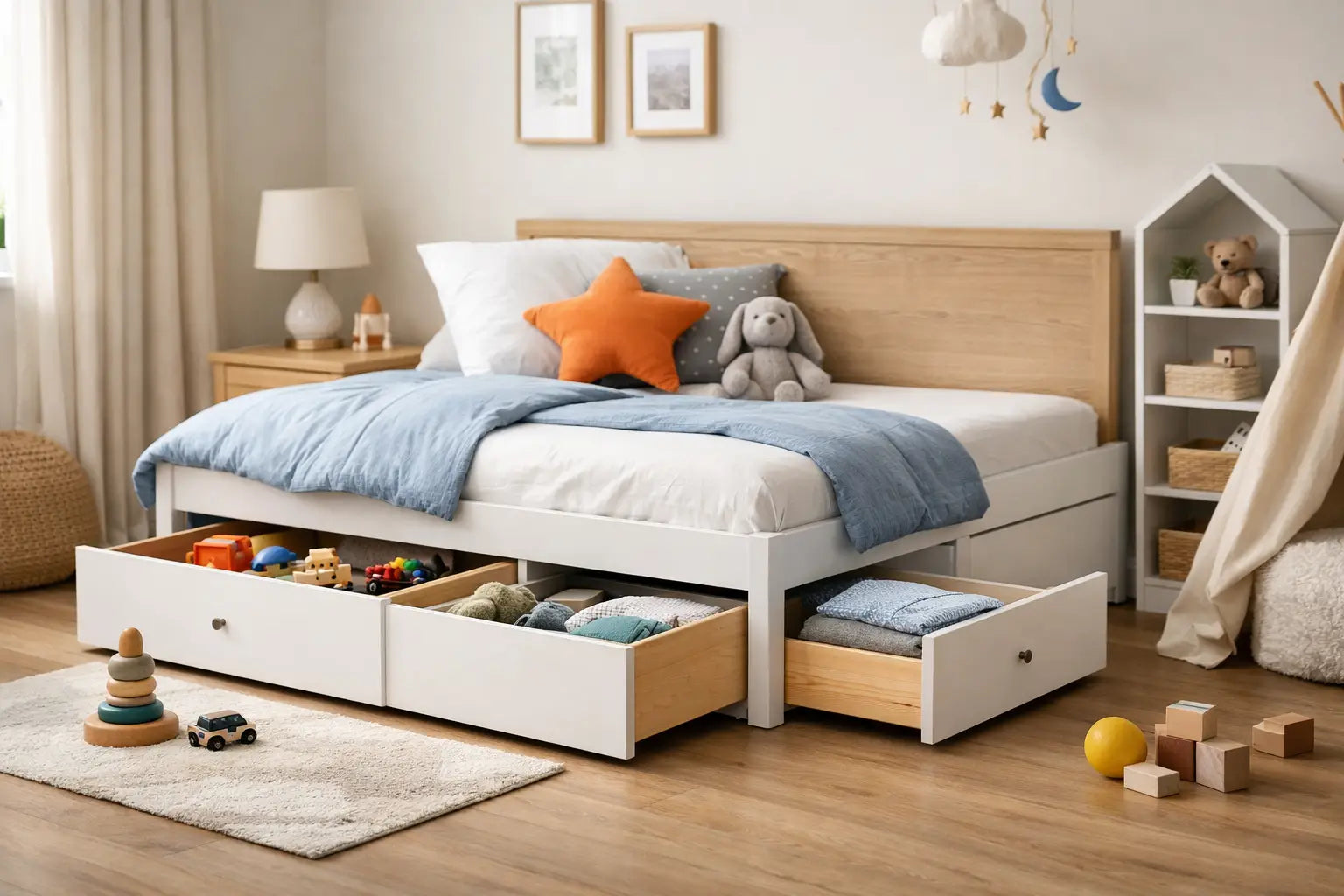
The quickest way for a beautifully planned child’s bedroom to feel overwhelmed is often not the furniture, but the belongings that have nowhere considered to go. A kids bed with storage drawers can change that daily rhythm, creating an elegant place for sleep while keeping spare bedding, seasonal clothes and toys close at hand but out of sight.
For families who want a room to feel calm rather than crowded, this is not simply a practical purchase. The right bed gives a child a more independent space, makes the evening tidy-up less of a negotiation and allows the rest of the room to remain free for play, reading and growing interests.
Why a kids bed with storage drawers earns its place
Drawers make use of one of the most underused areas in a bedroom: the space beneath the mattress. Unlike freestanding plastic boxes that gather dust and interrupt the look of the room, integrated storage feels intentional. It can support a more polished scheme, particularly when the bed is upholstered in a fabric and colour chosen to complement curtains, wall panels or a favourite reading chair.
There is a useful practical distinction between drawers and an ottoman-style base. A lift-up ottoman provides one large storage compartment and is excellent for bulky items, but drawers offer instant access. For everyday essentials such as pyjamas, school uniform, spare pillowcases or neatly folded jumpers, that convenience matters. A child can pull out one drawer, find what they need and put it back without disturbing the entire bed.
That said, drawers work best where the layout allows them to open fully. In a compact bedroom, an ottoman bed may be the more space-efficient option if furniture sits close beside the bed. The most beautiful solution is always one that suits how the room is actually used.
Plan the room before choosing a bed
A bed can look perfectly proportioned online yet feel far larger once it is in a child’s bedroom. Before deciding on a size, mark out the bed’s footprint on the floor with masking tape. Then add the projected depth of each open drawer. This simple exercise shows whether the drawers will clear a wardrobe, bedside table, radiator or bedroom door.
Choose a size with tomorrow in mind
A single bed is often a natural choice for younger children and smaller rooms. It leaves more floor space for playing, while still offering a generous sleeping area. A small double can be a lovely long-term choice for an older child or teenager, especially in a room that doubles as a relaxing retreat for reading, films and sleepovers.
The trade-off is straightforward: a larger mattress offers more room to stretch out, but its drawers need more clearance and can dominate a narrow room. Consider the child’s age, their height, the dimensions of the room and how long you expect the bed to remain in place. Buying for the next few years rather than the next few months often makes better sense.
Think about drawer orientation
Beds can be designed with drawers opening from the side, the foot end or a combination of positions. Side-opening drawers are usually the most accessible, provided there is sufficient walkway space. End drawers can be particularly useful in a narrow bedroom where the bed sits along a wall, although they may offer a little less immediate access.
Where a bed will be placed against a wall, confirm which side will remain open before ordering. A made-to-order bed should be tailored not only to a chosen fabric but to the realities of the room’s layout.
Be realistic about what will live inside
Under-bed drawers are wonderfully useful, but they are not a substitute for a full wardrobe. They are at their best when each drawer has a clear role. One might hold bedding and mattress protectors, another out-of-season clothes, and another soft toys or hobby supplies. When storage has a purpose, it is far less likely to become a place where everything disappears.
Look closely at construction and safety
A child’s bed should feel as reassuring in daily use as it looks. Check that the frame is solid, that drawer bases are properly supported and that the runners allow the drawers to glide smoothly without catching. Quality handles or discreet cut-out grips should be easy for small hands to use, with no sharp edges or loose detailing.
If the bed is upholstered, consider the practical qualities of the fabric alongside its appearance. A richly textured bouclé, soft velvet or woven neutral can bring warmth and personality, but a family bedroom also benefits from a durable finish that can be maintained with gentle regular care. Ordering fabric swatches before making a decision gives you the chance to see the colour in the room’s natural and artificial light, and to judge how it sits with existing furnishings.
The mattress depth also deserves attention. A very deep mattress can alter the overall height of the bed and reduce the visual balance of a headboard. For younger children, it is wise to consider how easily they can get in and out, particularly if the bed has a taller upholstered base. If the bed includes side rails, ensure the mattress specification is suitable for them and always follow the manufacturer’s guidance.
Drawers should be treated as storage, not steps or climbing equipment. Teaching children to close them fully after use helps protect fingers, keeps walkways clear and preserves the smooth operation of the furniture over time.
Create a bedroom that grows with them
Children’s tastes change quickly. A racing-car bed may delight a five-year-old, but a thoughtfully upholstered bed in a versatile shape can feel just as special now and still suit them years later. The personality can come through more easily changed elements: bedding, cushions, wall art, a bedside lamp or a colourful throw.
A softly padded headboard adds a sense of comfort and can make bedtime reading more inviting. Neutral shades such as warm stone, soft grey, oatmeal or muted blue create a restful foundation, while deeper tones can give an older child’s room a more confident, hotel-inspired finish. The aim is not to make a child’s bedroom overly formal. It is to give it enough longevity that it feels cared for at every stage.
At Hyder Living, the opportunity to choose fabric, colour, headboard style and storage arrangement makes it easier to achieve that balance between youthful character and enduring design.
Make the drawers work harder every day
The best storage is storage that is easy to maintain. Keep frequently used items in the most accessible drawer and reserve less convenient areas for items needed only occasionally. Folded bedding, spare duvets and winter knitwear are ideal candidates because they are soft, contained and unlikely to need daily attention.
Avoid forcing overfilled drawers shut. Not only does this make a bedroom harder to organise, it can put unnecessary pressure on the drawer fronts and runners. A little breathing room helps drawers continue to open smoothly and makes it easier for children to take responsibility for their own belongings.
For a shared room, separate storage by child rather than by category where possible. A designated drawer creates a small but valuable sense of ownership, particularly when siblings are learning to share a space gracefully.
Do not let storage distract from sleep comfort
Storage is valuable, but the mattress remains the part of the bed that supports restorative rest. Select a mattress that suits your child’s size, sleeping position and preferred feel, rather than choosing purely on depth or appearance. A supportive mattress with appropriate comfort layers can help make bedtime more inviting and provide the consistency growing bodies need.
Breathable bedding and a washable mattress protector are equally sensible additions. They help maintain a fresher sleep surface and protect the investment beneath, especially through the spills, colds and everyday adventures of family life. Rotate or turn the mattress according to its specific care instructions, as not all mattresses are designed to be flipped.
A well-designed bedroom should make winding down feel natural. When clothes are stored away, the floor is clear and the bed feels comfortable and inviting, the room becomes more than a place to sleep. It becomes a calm, personal haven your child can enjoy as they grow.
Questions worth asking before you order
Before committing to a bed, make sure you can answer four practical questions: Will every drawer open completely in the intended position? Is the mattress size and depth right for the frame? Does the fabric suit both the room and family life? And will the design still feel right when your child’s interests inevitably change?
A considered answer to those questions will lead you towards a bed that offers much more than extra storage. It will give the bedroom a calmer foundation, protect precious floor space and make each day feel a little more organised.
Share:
How Often to Rotate a Mattress for Better Sleep
Durable Mattresses for Hotels That Guests Trust