
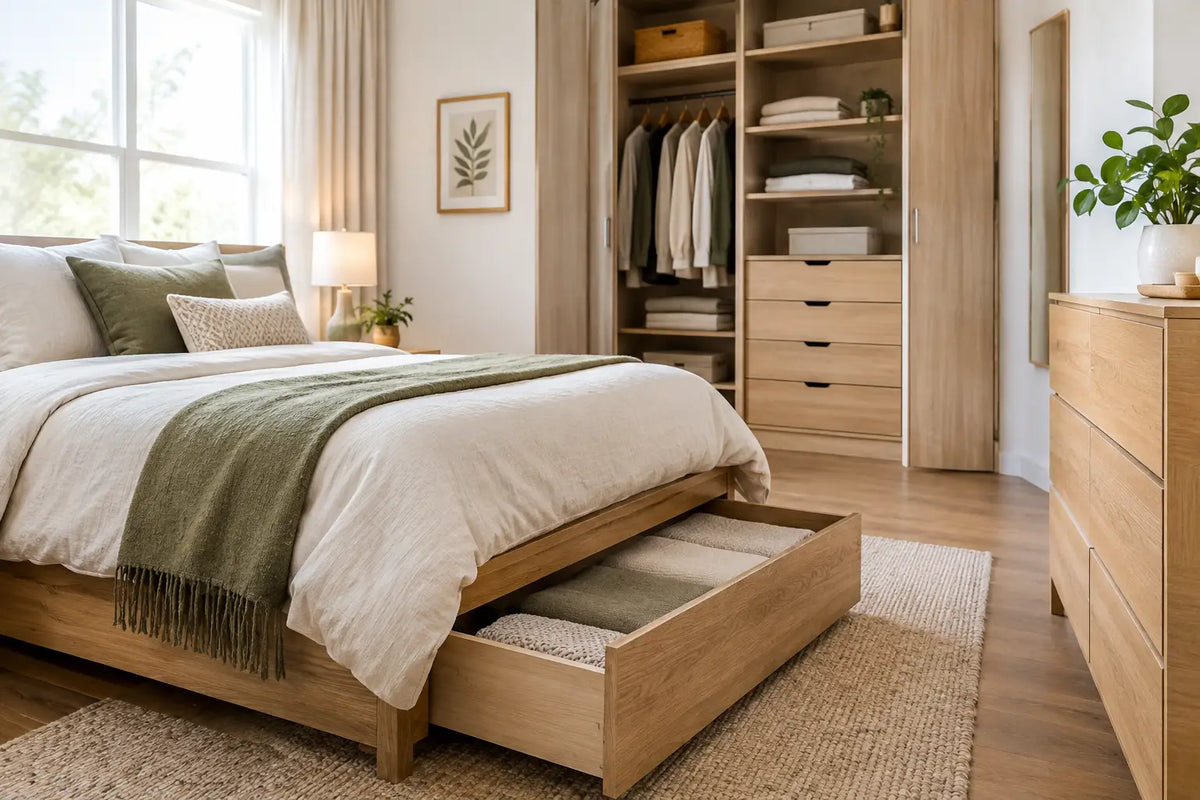
A beautifully appointed bedroom can lose its sense of calm remarkably quickly when suitcases live on the floor, spare bedding spills from a wardrobe and everyday essentials have nowhere discreet to go. The most effective bedroom storage ideas do more than create room for possessions. They preserve the visual quiet that makes a bedroom feel genuinely restorative, allowing the bed, lighting and considered finishes to take centre stage.
The best approach is rarely to add more furniture after the fact. It is to make each principal piece work harder, while retaining generous circulation around the bed and a composition that feels intentional. For a compact city flat, this may mean concealed storage beneath the mattress. In a larger home, it may mean beautifully tailored wardrobes and a dressing area designed around daily rituals.
Begin with the bed, not the clutter
The bed occupies the greatest footprint in most bedrooms, which makes it the natural place to begin. A storage solution that is built into this essential piece can remove the need for an additional chest, trunk or collection of under-bed boxes, leaving the room feeling more spacious rather than more furnished.
An ottoman storage bed is particularly well suited to households that value a polished interior but need meaningful capacity. The entire mattress platform lifts to reveal a generous, enclosed compartment, usually accessible from the foot end or side depending on the room layout. It is an elegant home for duvets, seasonal linens, pillows, guest bedding and luggage - items that are valuable to keep close but need not be seen every day.
For an elevated finish, consider the bed as part of the room's architecture. A deep upholstered frame in a fabric that complements curtains or a statement chair can make the storage function almost invisible. A tall headboard or upholstered wall panels draw the eye upward, giving the room a more composed, hotel-inspired proportion while the practical volume remains quietly below.
Choose the right under-bed format
Not all under-bed storage suits every room or routine. Ottoman beds offer the most uninterrupted volume and are ideal for bulkier pieces. They do, however, require lifting clearance and are best for belongings accessed occasionally rather than several times each week. Quality lift mechanisms make opening the base controlled and manageable, but it remains worth considering whether bedside tables, a bench or a low-hanging pendant will interfere with the opening path.
Drawer bases provide a different kind of convenience. Side drawers can be excellent for folded knitwear, accessories or children's toys, particularly where the bed is not close to a wall. They demand clear floor space to open fully, so they are less practical in a narrow bedroom. End drawers can work well in rooms where the sides of the bed are restricted, although their capacity is usually more limited.
If you prefer a bed frame with open clearance beneath it, choose shallow, matching containers with fitted lids rather than a mixture of visible plastic boxes. This can be a sensible option for a guest room or a home where the contents need frequent access. The trade-off is that the visual line under the bed needs regular attention; even attractive storage can look untidy when partially exposed.
Bedroom storage ideas that respect the room
A wardrobe should feel proportionate to the room and to the amount of clothing actually owned. An oversized freestanding piece can overwhelm a bedroom, while an under-sized one encourages the familiar chair piled with garments that are neither clean nor ready for the wash. Before selecting cabinetry, separate hanging clothes by length and identify what truly needs folding, hanging or drawer space.
A well-planned wardrobe interior often benefits from a combination of full-height hanging for dresses and coats, double hanging for shirts and trousers, shallow drawers for smaller garments, and adjustable shelves for knitwear. Shelf dividers are especially useful for preventing carefully folded stacks from collapsing after a busy morning. Soft, integrated lighting is a considered addition in a darker wardrobe, helping colours and fabrics read accurately without introducing more table lamps into the room.
For rooms with the budget and wall space, fitted wardrobes create a notably quieter result. They use awkward recesses and full ceiling height, and their doors can be specified to sit comfortably alongside panelling, paintwork or upholstery. Mirrored doors can increase light in a smaller room, although they are not universally flattering stylistically. In a more layered, traditional scheme, painted or upholstered door fronts may feel warmer and more private.
A chest of drawers remains valuable even with a substantial wardrobe. It offers a surface for a lamp, a framed photograph or a carefully chosen jewellery box, while keeping the smaller items that create visual noise out of sight. Avoid filling the top with day-to-day debris. A single lidded tray can hold watches, reading glasses and hand cream, giving essentials a defined home without sacrificing the sense of order.
Make seasonal storage feel effortless
The items that cause most bedroom congestion are often not the ones used every day. Winter duvets, holiday luggage, spare pillows, occasionwear and extra towels can consume valuable wardrobe space if they are not assigned a dedicated location.
Store soft furnishings in breathable cotton bags where possible, particularly natural-fill duvets and wool blankets. Vacuum bags can be useful for some synthetic bedding and bulky textiles, but prolonged compression is not ideal for delicate fibres or feather-filled pieces. Label containers discreetly and specifically - “king duvet cover sets” is far more useful than “linen” when preparing a guest room at short notice.
A blanket box at the foot of the bed can be a handsome choice in a generously sized room. It offers a place to put cushions and a bedspread at night, while adding a tactile layer of timber, leather or upholstery. In a smaller bedroom, however, a bench may become an obstacle rather than a luxury. The better choice is often to keep the floor open and place the same bedding within an ottoman base.
Do not overlook the small daily rituals
The difference between a bedroom that stays serene and one that constantly needs resetting is often found in the smallest storage decisions. A bedside table with a drawer conceals chargers, books and hand cream. A discreet cable channel or charging drawer avoids the tangle of leads that can undermine an otherwise considered scheme.
Jewellery, watches and accessories deserve storage that protects them as well as hides them. A lined drawer insert prevents pieces from becoming tangled, while a shallow tray can bring order to the contents of a dressing table. For fragrance bottles and skincare, resist keeping every product on display. Leave out the few pieces used daily and store the remainder in a cool, shaded drawer or cabinet.
Children's rooms benefit from the same principle, albeit with more flexible storage. Low drawers and labelled baskets encourage independence, while a bed with integrated storage provides a practical home for spare bedding, toys and out-of-season clothing. Choose durable handles, soft-close mechanisms and upholstery that suits the realities of family life as well as the intended look.
Plan storage around how you live
Before committing to furniture, measure the room with doors, radiators and window treatments in mind. Mark the bed footprint, opening arcs for wardrobe doors and drawers, and the route you take from bed to wardrobe each morning. A luxurious bedroom should never feel like an obstacle course.
It is also worth deciding what deserves to remain in the bedroom. Work papers, exercise equipment and overflowing laundry baskets all make practical demands on space, but they can dilute the room's purpose as a place for rest. Where possible, create a boundary: use concealed storage for essential items and relocate the rest.
For made-to-order beds, details such as size, opening direction, fabric and headboard height can be selected to suit the room rather than forcing the room to accommodate a standard design. Hyder Living's approach to upholstered beds makes this particularly valuable when a bedroom needs both a strong design statement and carefully concealed capacity.
The finest storage solution is the one you barely notice. When bedding, clothing and daily essentials each have an appropriate place, the room feels less managed and more inviting - ready for an unhurried evening and the kind of restorative sleep a beautifully designed bedroom should always support.
Share:
Choosing Fabrics for Bedrooms That Feel Luxurious