
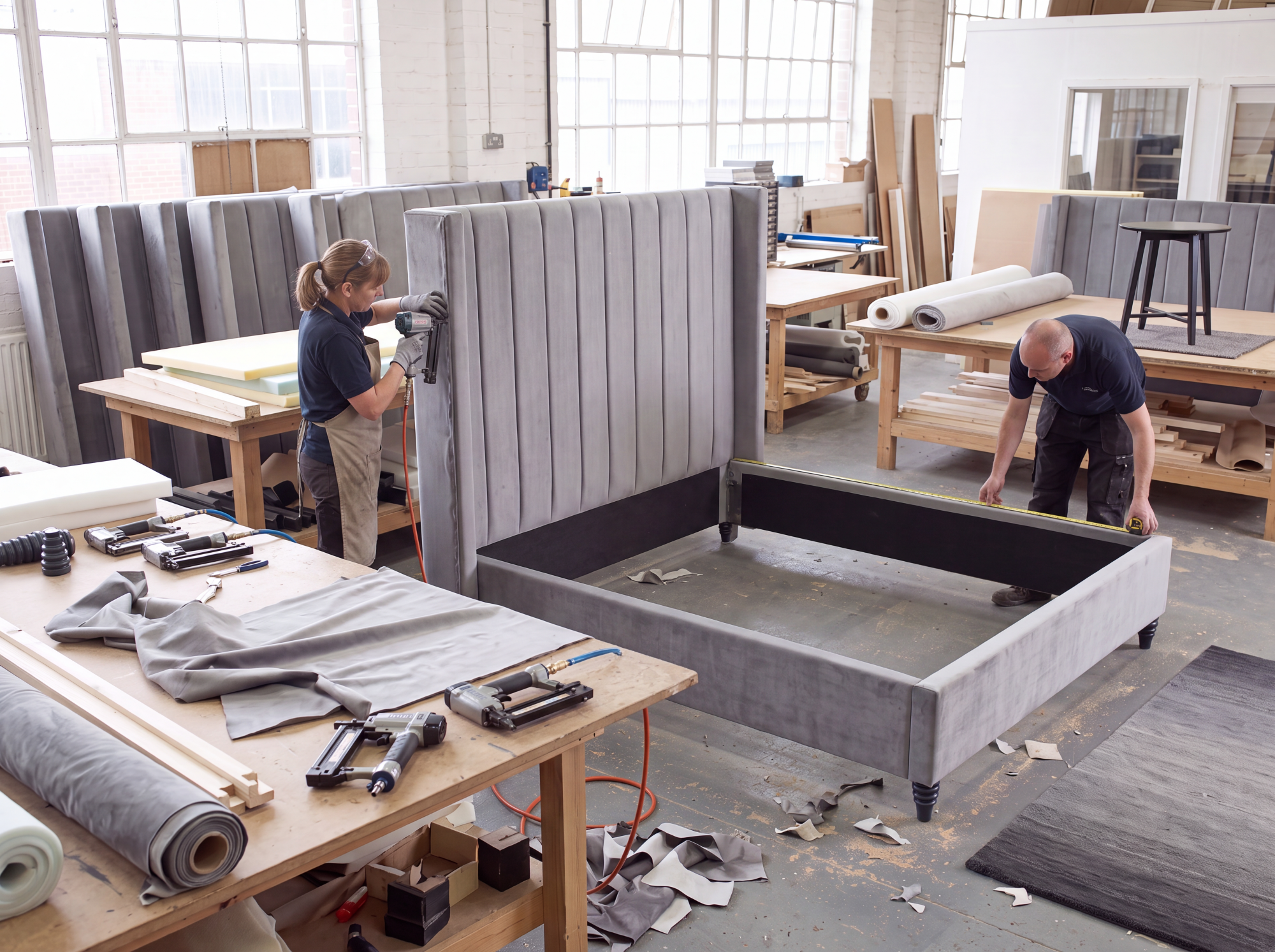
Fabric changes more than the colour of a bed. It affects how the bed reflects light, how large it appears and whether the room feels formal, relaxed, modern or traditional.
Two bed frames with the same shape can look completely different when one is upholstered in plush velvet and the other in linen.
H Living’s current fabric range includes Plush Velvet, Linen, Bouclé Everest, Oxford Cotton, Naples and Keylargo, with shades extending from ivory, cream and wheat to taupe, charcoal, fern and gunmetal.
Why Texture Changes Perceived Comfort
Comfort is partly physical and partly visual.
A fabric with a soft pile or deep texture can make the bed appear warmer and more inviting before it is touched. A flatter weave can create a cleaner and more tailored impression.
This matters because the bed is normally the largest upholstered object in the room. Its texture influences the atmosphere of the entire space.
Use texture deliberately:
- Soft pile creates visual warmth.
- Matte weaves feel calm and understated.
- Pronounced loops create depth and tactility.
- Smooth fabrics emphasise the shape of the frame.
- Reflective fabrics make panel details more visible.
Plush Velvet
Plush velvet is suitable for bedrooms that need richness, softness and stronger light variation.
Because the pile lies in a particular direction, the colour can appear lighter or darker as daylight moves across it. This adds depth to panelled headboards, winged beds and Chesterfield designs.
Velvet works particularly well with:
- Warm metallic lighting.
- Dark timber.
- Neutral walls.
- Panelled headboards.
- Deep buttoning.
- Hotel-inspired interiors.
In a compact bedroom, choose a lighter velvet such as beige, bone, ivory or light silver to reduce visual heaviness.
For households with pets, assess how easily loose hair can be removed and whether claw contact is likely. A fabric sample should be tested before ordering.
Linen
Linen provides a more relaxed, natural-looking finish.
Its visible weave absorbs rather than strongly reflects light, making it suitable for:
- Contemporary bedrooms.
- Coastal interiors.
- Scandinavian schemes.
- Natural timber furniture.
- Earthy colour palettes.
- Minimal bed designs.
Charcoal linen creates a sharper architectural effect, while wheat and lighter neutrals soften the room.
Linen is useful when the bed design is already detailed and the upholstery should remain understated.
Bouclé Everest
Bouclé has a highly tactile, looped surface that creates immediate depth.
It works especially well on simple bed shapes because the fabric itself supplies the visual interest. Plain headboards, curved headboards and softly rounded bed frames can all benefit from bouclé upholstery.
Bouclé is suited to:
- Warm neutral interiors.
- Contemporary organic design.
- Curved furniture.
- Textured rugs.
- Limewash-style walls.
- Natural stone and timber.
The pronounced texture can collect loose fibres or pet hair more visibly than a flatter weave. Test the sample against the practical demands of the household.
Oxford Cotton
Oxford cotton has a structured woven appearance. It sits between casual linen and highly decorative velvet.
It works well when the room needs texture without shine.
Consider it for:
- Family bedrooms.
- Neutral schemes.
- Traditional-modern interiors.
- Panelled headboards.
- Rooms with patterned curtains or wallpaper.
- Bedrooms containing several different materials.
Colours such as natural, ivory, stone, desert and celery can complement both warm and cool wall finishes.
Naples and Keylargo
Fabric names alone do not reveal how a material will behave in your room.
Naples and Keylargo offer additional texture and colour options within H Living’s range, but they should be judged through physical samples rather than assumptions based on the category name.
Assess:
- Surface softness.
- Weave direction.
- Light reflection.
- Colour variation.
- Resistance to visible marking.
- Compatibility with the chosen bed design.
A fabric that looks grey online may appear blue, beige or green under different lighting.
Match the Fabric to Natural Light
The direction and strength of daylight can alter upholstery colour.
North-Facing Bedrooms
North-facing rooms often receive cooler light. Blue-grey fabrics may appear colder than expected.
Consider:
- Wheat.
- Beige.
- Bone.
- Ecru.
- Taupe.
- Warm ivory.
South-Facing Bedrooms
South-facing rooms receive stronger, warmer light. This can support cooler greys, greens and deeper neutral shades.
Consider:
- Steel.
- Smoke.
- Silver.
- Charcoal.
- Fern.
- Gunmetal.
Low-Light Bedrooms
In a dark room, heavily textured dark fabric may make the bed appear larger and heavier.
Use lighter upholstery and introduce contrast through cushions, throws or wall colour instead.
Choosing Fabric for Homes with Children or Pets
No upholstery is completely maintenance-free.
For a busy household:
- Avoid selecting by appearance alone.
- Compare how easily the fabric can be vacuumed.
- Check whether the texture catches claws.
- Consider whether marks will be obvious.
- Choose mid-tone colours where practical.
- Keep fabric-care instructions available.
- Test cleaning methods on a hidden area.
Very pale fabrics can show spills more readily. Very dark fabrics can show dust, lint and light-coloured pet hair.
Mid-tone taupe, stone, mushroom and textured grey shades often disguise everyday variation more effectively.
Fabric and Bed Design Must Work Together
Highly detailed bed designs do not always need highly decorative fabric.
Use the following combinations as a guide:
- Chesterfield or deep buttoned headboard: velvet or a smooth fabric that reveals the upholstery detail.
- Plain headboard: bouclé or textured cotton to introduce interest.
- Vertical panel headboard: velvet to emphasise changing light across each panel.
- Winged headboard: linen or velvet depending on whether the room is relaxed or formal.
- Low-profile bed frame: textured neutral fabric to prevent the design appearing flat.
- Large bespoke headboard: restrained colour where scale already creates impact.
Wall-Paint Matching Checklist
Before finalising the fabric, check the following:
- Is the wall paint warm, cool or neutral?
- Does the fabric contain a hidden green, blue, pink or yellow undertone?
- Does the sample work in both daylight and artificial light?
- Does it complement the flooring?
- Does it coordinate with curtains and blinds?
- Is there enough contrast between the bed and wall?
- Will the fabric still work if bedding colours change?
- Does the texture compete with wallpaper or wall panelling?
- Does the shade suit the size of the room?
- Have you viewed the sample vertically as well as horizontally?
Place the sample against the wall behind the bed and examine it at several times of day.
Always Order Samples
Digital screens cannot represent texture, pile direction or undertones reliably.
H Living provides free fabric samples so customers can compare materials within the actual bedroom before specifying handmade upholstered beds, divans or headboards.
The correct fabric is not simply the one that looks most luxurious in isolation. It is the one that works with the room’s light, wall colour, flooring, lifestyle and bed design.
6. The Unsung Hero of Bedroom Design: Why Your Headboard Matters
Meta description: Discover how headboard height, upholstery and shape affect comfort, acoustics and the overall bedroom design.
The mattress determines how the bed feels beneath you, but the headboard often determines how the entire bedroom looks.
It anchors the bed, creates a focal point and connects the furniture to the proportions of the wall. An upholstered headboard can also improve comfort when reading or sitting upright.
H Living’s current range includes plain, panelled, Chesterfield, half-moon and winged designs, together with floor-standing, wall-mounted and strutted configurations.
The Headboard Creates the Main Focal Point
Most bedrooms contain several functional objects:
- Bedside tables.
- Wardrobes.
- Lighting.
- Curtains.
- Drawers.
- Mirrors.
Without a strong focal point, these pieces can appear disconnected.
A headboard gives the room a visual centre. It frames the mattress and draws attention to the bed as the main purpose of the room.
The design can either lead the scheme or support it.
A tall winged headboard creates a clear statement. A plain low headboard provides structure without dominating the wall. A panelled design introduces rhythm, while a Chesterfield finish adds decorative depth.
Upholstery Changes the Atmosphere
A hard headboard creates a sharper, more architectural appearance. Upholstery softens the transition between the bed and wall.
Fabric can make the room feel:
- Warmer.
- Quieter.
- More comfortable.
- More finished.
- More coordinated.
- Less visually severe.
Plush velvet produces depth and light variation. Linen creates a calmer, matte appearance. Bouclé adds tactility, while Oxford cotton gives a structured woven finish.
Matching the headboard and divan base creates a unified bed. Choosing a contrasting headboard can create a more individual, furniture-led look.
Headboards and Sound
An upholstered headboard will not soundproof a bedroom.
It can, however, soften some local sound reflections because fabric, padding and irregular surfaces absorb more sound than a completely bare hard wall.
The effect is usually subtle. It is most noticeable around the bed rather than across the entire room.
A headboard may help a bedroom feel acoustically softer when combined with:
- Curtains.
- Rugs.
- Upholstered furniture.
- Bedding.
- Cushions.
- Wall panels.
For substantial noise problems, improvements to doors, windows, walls and gaps will matter more than the headboard.
Better Support for Reading and Relaxing
Many people use the bed for more than sleeping.
An upholstered headboard creates a more comfortable surface for:
- Reading.
- Watching television.
- Drinking morning tea.
- Working briefly on a laptop.
- Supporting pillows.
- Sitting upright during recovery from illness.
The amount of comfort depends on the construction.
A thin, decorative headboard may look attractive but provide limited cushioning. A deeper padded headboard offers more support but may reduce the usable mattress length slightly if it projects forward.
Pillows should still be used. The headboard is a supportive backdrop rather than a replacement for appropriate back and neck support.
Choose Height According to Ceiling Proportions
Headboard height should be considered in relation to the wall, not just the bed.
Lower Ceilings
In a room with a lower ceiling:
- Choose moderate height.
- Avoid an excessively deep top profile.
- Use vertical panels to create height without bulk.
- Keep the upholstery similar to the wall colour.
- Avoid overcrowding the wall above the headboard.
A tall headboard can still work, but it should leave enough visible wall to prevent the room feeling compressed.
Standard Ceilings
Standard UK bedrooms can accommodate most floor-standing headboards.
Panelled, Chesterfield, plain and winged designs can all work, depending on bed width and surrounding furniture.
Use bedside lighting to frame the headboard rather than placing small decorative items above it.
High Ceilings
A high-ceilinged bedroom can make a standard headboard appear undersized.
Consider:
- A taller floor-standing headboard.
- Wider side wings.
- Extended upholstered wall panels.
- Strong vertical detailing.
- Deeper colour.
- Larger bedside lamps or pendants.
The aim is to give the bed enough visual weight to hold the wall.
Select the Style According to the Room
Plain Headboards
A plain headboard is versatile and allows the fabric texture to carry the design.
Best suited to:
- Minimal bedrooms.
- Patterned wallpaper.
- Strong artwork.
- Small rooms.
- Bouclé or textured upholstery.
Panelled Headboards
Vertical or horizontal panels create structure.
Vertical panels visually increase height. Horizontal panels emphasise width and can make the bed appear broader.
H Living currently offers multiple panel configurations, including two-panel through nine-panel designs and herringbone variations.
Chesterfield Headboards
Buttoning introduces depth, shadow and a traditional upholstery reference.
Use Chesterfield designs in:
- Hotel-inspired rooms.
- Traditional-modern interiors.
- Bedrooms with simple wall finishes.
- Schemes using velvet or smoother fabrics.
Winged Headboards
Wings create a more enclosed appearance and strengthen the bed’s presence.
Before ordering, check that the additional width does not interfere with:
- Plug sockets.
- Light switches.
- Bedside tables.
- Wall lights.
- Wardrobe doors.
Half-Moon and Curved Headboards
Curved forms soften rooms containing many straight lines.
They work well with rounded bedside tables, globe lighting and organic contemporary interiors.
Floor-Standing, Strutted or Wall-Mounted?
Floor-Standing
A floor-standing headboard rests on the floor and attaches to the bed.
Benefits include:
- Strong visual presence.
- Stable positioning.
- Premium proportions.
- Suitability for taller designs.
Strutted
A strutted headboard attaches to the bed using vertical supports.
It is usually easier to move and may suit smaller, lighter designs.
Wall-Mounted
A wall-mounted headboard is fixed independently of the bed.
It can create a clean, fitted appearance and allows the design to extend beyond the bed width. Installation must account for wall construction and fixing strength.
H Living offers floor-standing, wall-mounted and bespoke headboard solutions across residential, retail and contract applications.
Headboard Measuring Checklist
Before ordering bespoke headboards, confirm:
- Mattress width.
- Divan or bed-frame width.
- Total available wall width.
- Ceiling height.
- Skirting-board depth.
- Socket positions.
- Light-switch positions.
- Bedside-table height.
- Wall-light location.
- Access through stairs, halls and doorways.
- Whether side wings add to the stated width.
- Whether the headboard stands on the floor or mounts to the wall.
Measure the access route as carefully as the bedroom. A large headboard may fit the wall but fail to pass through a narrow staircase or landing.
The Headboard Completes the Bed
A headboard should not be treated as an optional panel added after the rest of the bedroom has been designed.
It affects comfort, scale, texture, colour and visual balance. It can make a standard divan look considered, connect the bed to the architecture and reduce the need for additional decoration behind it.
The mattress supports the sleeper. The headboard completes the room.
Share:
How to Reclaim 30% of Your Bedroom Floor Space
How to Choose Mattress Firmness for Better Sleep