
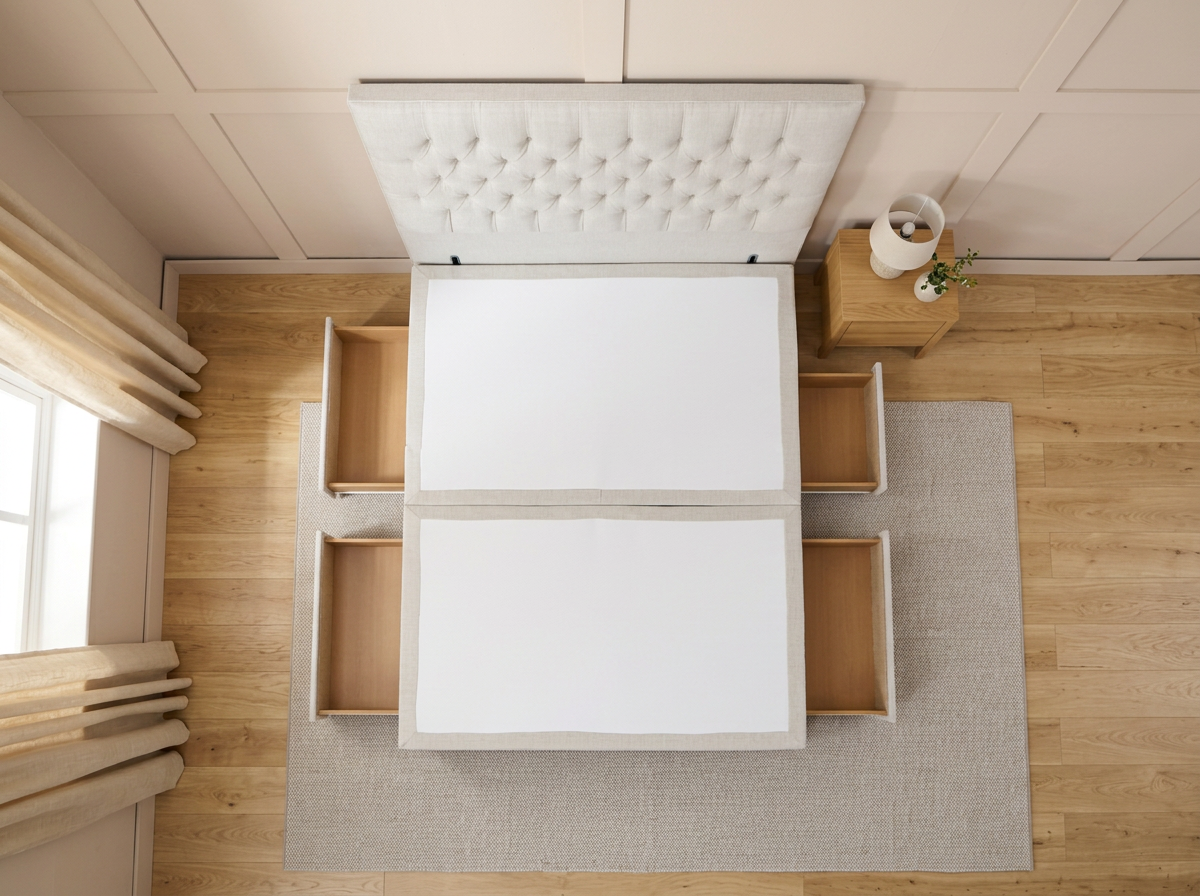
A bed is usually the largest object in a bedroom. In a compact room, it can occupy close to one-third of the available floor area.
That space cannot be removed, but it can be made to perform two functions: sleeping above and storage below.
This is the principle behind ottoman beds and custom divan storage. They do not make the room physically larger. They allow the largest footprint in the room to work more efficiently.
The Space-Saving Mathematics
Consider a compact bedroom measuring 3 metres by 3 metres.
Its total floor area is:
3 m × 3 m = 9 square metres
A standard UK double bed measures approximately 1.35 metres by 1.90 metres.
Its mattress footprint is:
1.35 m × 1.90 m = 2.57 square metres
The bed therefore occupies approximately 28.5% of the room’s floor area before allowing for the external dimensions of the frame.
This is why the claim of reclaiming around 30% of a compact bedroom is reasonable—but only when “reclaiming” means putting the bed’s footprint to additional use.
Instead of using that 2.57-square-metre area solely for sleeping, an ottoman or drawer divan converts it into concealed storage.
Why Conventional Storage Can Make the Problem Worse
When storage is limited, the usual response is to add more furniture:
- A wider wardrobe.
- A chest of drawers.
- A blanket box.
- Freestanding shelves.
- Under-window cabinets.
- Storage benches.
Each item takes away more floor space and can restrict movement around the bed.
A storage bed reverses the process. It uses an area that has already been allocated to furniture.
H Living currently offers two-drawer, four-drawer, front-opening ottoman and side-opening ottoman divan configurations, allowing storage access to be matched to the room layout.
A Clutter-Free Room Feels More Restful
Clutter does not affect everyone in the same way, and a tidy bedroom is not a medical treatment for poor sleep. However, visual simplicity can make the room feel calmer and easier to maintain.
Removing visible storage boxes, bags and piles of clothing creates:
- Clearer walking routes.
- Less visual competition.
- Easier cleaning.
- A stronger focal point around the bed.
- More visible flooring.
- A greater sense of proportion.
The purpose is not to create an empty showroom. It is to remove objects that do not need to remain visible.
A well-upholstered storage bed can then become the main design feature instead of being surrounded by practical but mismatched storage furniture.
What to Store Under the Bed
Under-bed storage is most effective when used deliberately.
Seasonal Bedding
Store items according to the time of year:
- Winter duvets.
- Summer duvets.
- Electric blankets.
- Heavy throws.
- Spare mattress protectors.
- Seasonal cushion covers.
Wash and dry textiles fully before storing them.
Out-of-Season Clothing
Vacuum bags can reduce the volume of:
- Coats.
- Knitwear.
- Ski clothing.
- Summer clothing.
- Occasion wear.
- Spare uniforms.
Avoid over-compressing delicate natural fibres for long periods.
Guest Items
Keep guest bedding together in a labelled fabric bag or storage box:
- Duvet cover.
- Fitted sheet.
- Pillowcases.
- Towels.
- Spare pillows.
This prevents separate items from being scattered across different cupboards.
Suitcases and Travel Equipment
Suitcases consume a large amount of wardrobe space. A continuous ottoman compartment is often more suitable than drawers for luggage, holdalls and travel accessories.
Organise the Interior into Zones
A large ottoman compartment provides flexibility, but it can become disorganised without internal zoning.
Divide it into three sections:
Frequently Used
Place these items closest to the opening:
- Spare bedding.
- Towels.
- Everyday bags.
- Regularly rotated clothing.
Seasonal
Position these in the centre:
- Winter or summer bedding.
- Seasonal clothes.
- Holiday items.
Rarely Used
Place these furthest from the opening:
- Keepsake textiles.
- Formal bedding.
- Spare curtains.
- Travel equipment.
Use soft-sided, breathable storage bags where appropriate. Rigid boxes can be useful, but their height must not interfere with the closing platform or lifting mechanism.
Choose the Correct Opening Direction
Storage capacity is irrelevant when access is awkward.
A front-opening ottoman is often suitable when:
- The foot of the bed is unobstructed.
- Both sides sit close to walls.
- Bedside furniture limits side access.
A side-opening ottoman may work better when:
- One long side of the bed remains clear.
- The foot faces a wall or television unit.
- The room is narrow but long.
Drawer divans require horizontal clearance. Measure the fully usable gap rather than the apparent gap.
A bedside cabinet may leave enough room to see the drawer but not enough room to open it.
Use Upholstery to Reduce Visual Weight
Large storage furniture can appear heavy. Upholstery helps integrate the bed into the room rather than making it look like a storage unit.
The texture and colour affect how substantial the bed appears:
- Light linen creates a softer, more open appearance.
- Neutral Oxford cotton feels structured without excessive shine.
- Plush velvet reflects light and adds depth.
- Bouclé introduces visible texture and warmth.
- Dark fabrics create definition but may appear heavier in a small room.
H Living’s current upholstery choices include Linen, Plush Velvet, Bouclé Everest, Naples, Keylargo and Oxford Cotton in a broad neutral and muted colour palette.
Keep Storage Practical
Do not treat the compartment as a place to hide everything without organisation.
Follow four rules:
- Store only clean and dry items.
- Keep frequently used items near the opening.
- Avoid exceeding the recommended load.
- Check that nothing obstructs the mechanism.
Review the contents twice a year. Under-bed storage should reduce clutter, not preserve items that are no longer required.
Make the Largest Item Work Harder
In a compact bedroom, replacing the bed with a smaller model may not be realistic or desirable.
A more effective approach is to make the existing footprint work harder.
By combining a supportive bed base, practical hidden storage and suitable upholstery, the bed becomes the room’s sleeping surface, storage system and visual centre. That is how nearly 30% of a compact bedroom can be reclaimed without reducing the mattress size.
Share:
Ottoman vs. Drawer Divans: Which Storage Bed Is Right for You?
How to Choose the Perfect Upholstery Fabric for Your Bedroom Aesthetic