
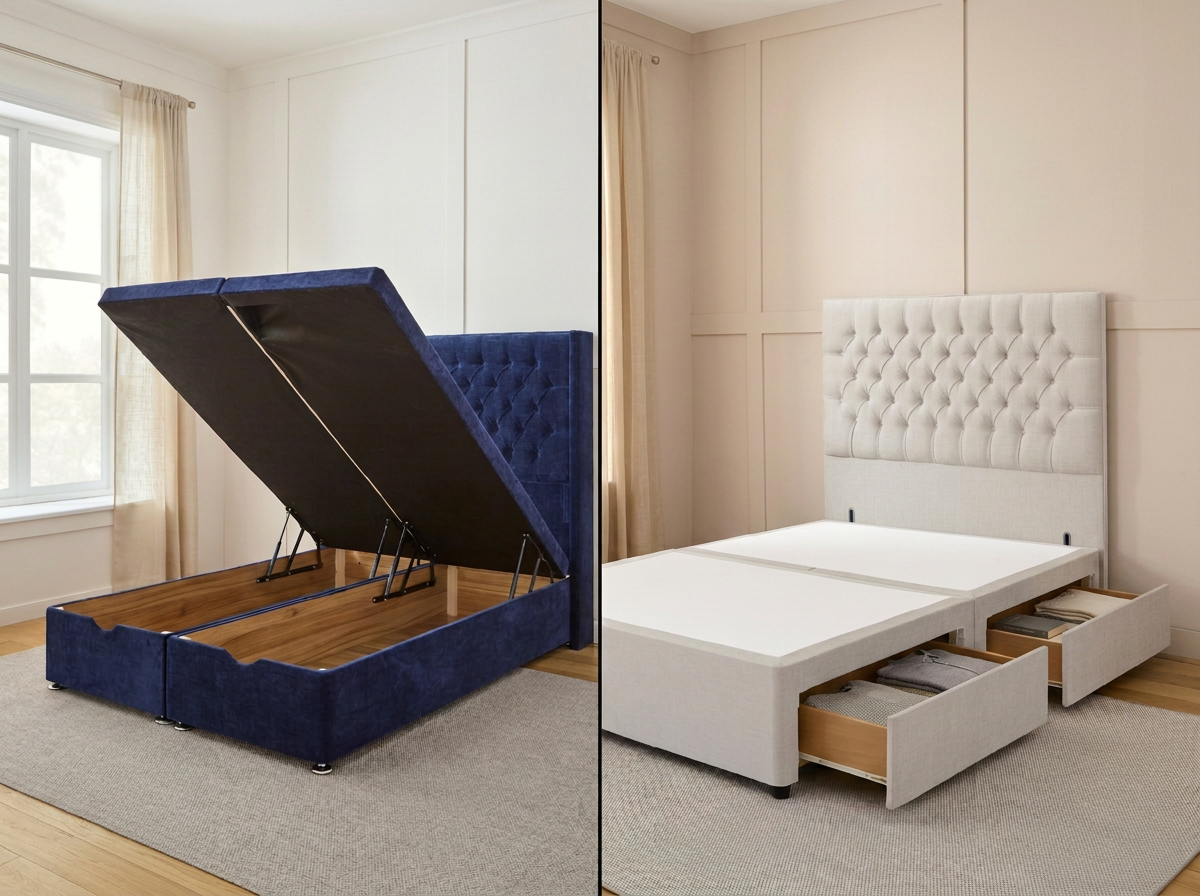
Storage beds solve a common bedroom problem: the bed occupies a large area of the floor, but the space beneath it is often unused.
Both ottoman and drawer divans convert this area into practical storage. The correct choice depends on the shape of the room, the items being stored and how frequently they need to be accessed.
H Living’s current custom divan storage range includes two-drawer divans, four-drawer divans, front-opening ottomans and side-opening ottomans, as well as standard and reinforced bases.
Ottoman and Drawer Divans Compared
| Consideration | Ottoman Divan | Drawer Divan |
|---|---|---|
| Best room type | Compact rooms where side clearance is limited | Rooms with clear access beside the bed |
| Access method | Mattress platform lifts from the side or foot end | Individual drawers pull out horizontally |
| Storage volume | Usually provides access to most of the internal base | Divided into separate drawer compartments |
| Best for | Bulky, seasonal or occasional-use items | Smaller items needed more frequently |
| Floor clearance needed | Little or no drawer-pull space | Clear floor space required in front of each drawer |
| Organisation style | Large continuous compartment | Naturally divided storage |
| Typical use | Duvets, suitcases, bedding and seasonal clothes | Clothing, shoes, towels and spare linen |
How Much Can an Ottoman Bed Hold?
Exact capacity depends on the bed size, internal construction, mechanism and usable storage depth. However, a simple calculation demonstrates why ottoman beds are effective.
A standard UK double mattress measures approximately 135 cm by 190 cm. That gives the bed a footprint of about 2.57 square metres.
If an ottoman provided an illustrative usable depth of 25 cm across that full footprint, the gross geometric space would be:
1.35 m × 1.90 m × 0.25 m = approximately 0.64 cubic metres
That is roughly 640 litres before allowing for internal framing, hinges, mechanisms and clearance. This is an illustration rather than a capacity specification for a particular H Living product.
The main advantage is not simply the headline volume. It is the shape of the compartment. A continuous storage area can accommodate items that would not fit comfortably into drawers, including:
- Large suitcases.
- Winter duvets.
- Vacuum-packed clothing.
- Spare pillows.
- Folded mattress protectors.
- Guest bedding.
- Long storage boxes.
When an Ottoman Divan Works Best
An ottoman is usually the strongest choice when maximum concealed storage is required.
Small Apartments
In a compact apartment, there may not be enough clearance to open drawers at both sides of the bed. A lift-up platform allows access from above instead.
A side-opening ottoman may work well when one long side of the bed remains accessible. A front-opening model may suit a room where both sides are close to walls but the foot of the bed remains clear.
Rooms with Limited Furniture
An ottoman can reduce the need for a separate blanket box, chest or additional wardrobe. This helps prevent the room from becoming overcrowded.
Seasonal Storage
Ottoman compartments are particularly useful for larger items that are only accessed occasionally. Store winter bedding during summer, then rotate lighter bedding into the compartment as the seasons change.
Visually Minimal Bedrooms
Because the storage is completely concealed, an ottoman maintains the clean appearance of a standard upholstered divan.
H Living’s front-opening ottoman base includes a strong upholstered structure, an anti-slip mattress surface and a lift-up storage compartment.
When a Drawer Divan Works Best
Drawers provide quicker, more selective access.
You do not need to lift the mattress platform or move bedding. Open one drawer, retrieve the item and close it again.
Larger Main Bedrooms
Drawer divans suit rooms with enough circulation space beside the bed. Before ordering, measure the distance between the bed and:
- Bedside tables.
- Wardrobes.
- Radiators.
- Walls.
- Bedroom doors.
- Other furniture.
The drawer must open far enough to provide useful access.
Frequently Used Items
Drawers are practical for items used weekly or daily:
- Spare pillowcases.
- Towels.
- Nightwear.
- Shoes.
- Lightweight blankets.
- Children’s bedding.
- Clothing accessories.
Organised Storage
A four-drawer divan naturally separates items into categories. A two-drawer divan offers less capacity but may preserve access where bedside cabinets occupy part of the room.
Two Drawers or Four?
A two-drawer divan generally places storage at the lower half of the bed, avoiding the area commonly occupied by bedside tables.
This configuration is suitable when:
- The bed sits between two bedside cabinets.
- Only moderate storage is required.
- The upper sides of the base are obstructed.
- Larger drawers are preferred over several compartments.
A four-drawer divan increases divided storage but requires greater side access.
Before choosing four drawers, check that all four can open. A drawer that is permanently blocked by furniture adds cost without creating usable storage.
Mechanism Durability and Construction
The effectiveness of an ottoman bed depends on more than the size of the compartment.
The lift system must work with:
- The weight of the mattress.
- The strength of the platform.
- The rigidity of the internal frame.
- The hinge positions.
- The frequency of use.
H Living uses reinforced ottoman construction intended to support regular residential and contract use. The mechanism assists the lifting movement, but it should still be operated correctly and kept within the specified loading guidance.
Always lift from the designated handle or access point. Do not pull from one corner, overload the compartment or allow loose items to obstruct the closing mechanism.
Which Storage Bed Should You Choose?
Choose an ottoman divan when:
- Maximum storage is the priority.
- The bedroom is compact.
- Drawer clearance is restricted.
- You need to store bulky items.
- Most stored items are used occasionally.
Choose a drawer divan when:
- You need frequent, quick access.
- The room has sufficient side clearance.
- You prefer divided compartments.
- You store smaller household items.
- Lifting the mattress platform would be inconvenient.
The best storage bed is not automatically the model with the greatest theoretical volume. It is the one you can access easily within the actual layout of your bedroom.
Share:
Why Your Mattress Makes All the Difference
How to Reclaim 30% of Your Bedroom Floor Space