
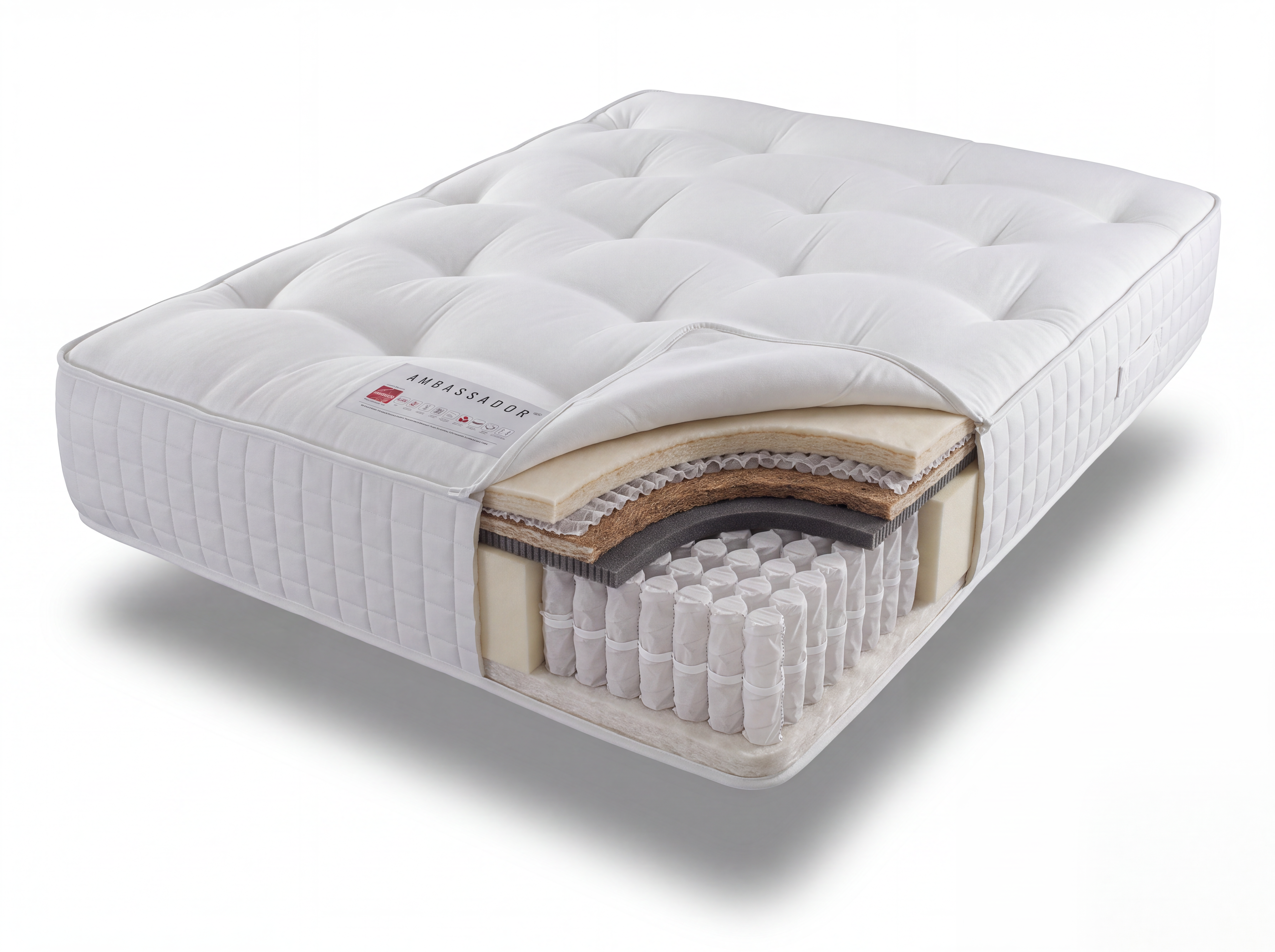
A mattress is sometimes judged within seconds: soft or firm, comfortable or uncomfortable. That first impression matters, but it does not reveal how the mattress will perform over an entire night.
The more important questions are structural:
- Does it support your body evenly?
- Does it allow your spine to remain comfortably aligned?
- Does it relieve concentrated pressure?
- Does it limit movement from a sleeping partner?
- Does it continue to perform after regular use?
This is why choosing a mattress should involve more than pressing a hand into the surface in a showroom.
Spinal Alignment Is More Important Than Surface Softness
Your spine has natural curves. A suitable mattress should support those curves without forcing the body into an exaggerated position.
When a mattress is excessively soft, heavier areas such as the hips may sink too deeply. When it is excessively firm, the shoulders and hips may remain elevated while the waist receives insufficient support.
Neither situation is ideal.
The aim is not to make the spine completely straight in every position. It is to keep the body in a comfortable, neutral posture while distributing weight appropriately.
For a side sleeper, this normally means allowing enough cushioning around the shoulder and hip while supporting the space around the waist. For a back sleeper, the mattress must prevent excessive sinking around the pelvis while maintaining support beneath the lower back.
Research reviews suggest that mattress design, firmness and pressure distribution can influence sleep comfort, spinal alignment and musculoskeletal symptoms. However, there is no single construction that suits every body type.
Pressure Relief and Support Are Different
The words “support” and “comfort” are often used as though they mean the same thing.
They perform different functions.
Support
Support is primarily created by the mattress core. This may include:
- Pocket springs.
- Traditional spring systems.
- Reflex foam.
- Latex.
- Hybrid combinations.
The support system controls how far different parts of the body sink and how effectively weight is distributed.
Comfort
Comfort is influenced by the upper layers and surface finish. These layers soften the initial feel and reduce pressure around prominent areas.
They may include:
- Memory foam.
- Gel-infused foam.
- Cooling foam.
- Latex.
- Wool or fibre fillings.
- Quilted or tufted covers.
A mattress can feel soft on top while remaining structurally supportive underneath. Equally, a mattress can feel firm at first contact but fail to support the body evenly.
Pressure-mapping research has shown that body shape, weight, sleeping position and mattress surface all influence how pressure is distributed.
Motion Transfer Matters for Couples
A mattress may feel comfortable when one person lies still but perform poorly when two people share it.
Movement from turning over, getting into bed or leaving the bed can travel across the mattress. This is known as motion transfer.
Pocket-sprung mattresses are frequently selected by couples because the springs move more independently than a fully interconnected spring unit. Memory foam can also absorb movement effectively because it responds locally rather than rebounding across the entire surface.
Research into bed sharing confirms that one partner’s movement and wakefulness can influence the other sleeper.
Motion isolation becomes especially important when:
- One person is a light sleeper.
- Partners have different working schedules.
- One sleeper changes position frequently.
- There is a significant difference in body weight.
- One person regularly gets out of bed during the night.
Handmade Versus Mass-Produced: The Tailored-Suit Analogy
A mass-produced mattress can be compared with a one-size-fits-all suit. It may be acceptable for many people, but its proportions have been created around a broad average.
A handmade mattress is closer to a custom-fit suit.
The purpose is not unnecessary complication. It is better control over the fit.
A considered mattress specification can account for:
- Body weight.
- Preferred sleeping position.
- Desired firmness.
- Pressure sensitivity.
- Temperature preference.
- Whether the mattress will be shared.
- The type of bed base being used.
H Living’s mattress approach reflects this tailored philosophy, offering different spring counts and comfort-layer combinations rather than relying on one universal construction. Its current range includes standard pocket-sprung models and variations using memory, reflex, gel, cooling and zero-gravity comfort layers.
This does not mean that the mattress must be unusually soft, thick or expensive. It means the internal components should serve a clear purpose.
Firmness Is Personal, but It Is Not Random
Firmness labels are useful starting points rather than universal measurements.
A medium mattress may feel firmer to a lighter sleeper because they do not compress the layers as deeply. The same mattress may feel softer to a heavier sleeper.
Sleeping position also changes the requirement:
- Side sleepers: usually require more surface cushioning around the shoulder and hip.
- Back sleepers: generally need balanced support around the pelvis and lower back.
- Front sleepers: often require greater resistance against excessive pelvic sinking.
- Combination sleepers: normally benefit from a responsive surface that allows easier movement.
Medium-firm mattresses have performed well in several studies, particularly when compared with very firm surfaces, but personal fit remains essential.
The Bed Base Changes Mattress Performance
A mattress does not work in isolation.
A platform-top divan provides a stable, even foundation and generally creates a firmer overall feel. A sprung base introduces additional flexibility. Slatted bed frames can provide effective support, but the quality, spacing and condition of the slats matter.
Placing a new mattress on an unsuitable or damaged base can affect:
- Comfort.
- Weight distribution.
- Edge stability.
- Mattress settlement.
- Long-term durability.
H Living produces platform-top, reinforced, drawer and ottoman divan options designed to provide a consistent supporting surface.
A Practical Luxury Mattress Guide
Before buying, answer the following questions:
- What position do you sleep in most frequently?
- Do you prefer to lie “on” or “in” the mattress?
- Do you regularly become too warm?
- Do you share the bed?
- Is movement from your partner disruptive?
- Do your shoulders or hips feel pressured?
- What base will support the mattress?
- Is your current mattress visibly uneven?
- Do you wake with stiffness that improves after getting up?
- Have you tested more than one firmness level?
A mattress should not be selected because it carries the highest spring count or the thickest comfort layer. Components must work together.
The best mattress is the one that supports your body consistently, accommodates your sleeping position and remains comfortable for the full night—not merely the first five minutes.
Share:
Expert Tips for Better Sleep Tonight
Ottoman vs. Drawer Divans: Which Storage Bed Is Right for You?