
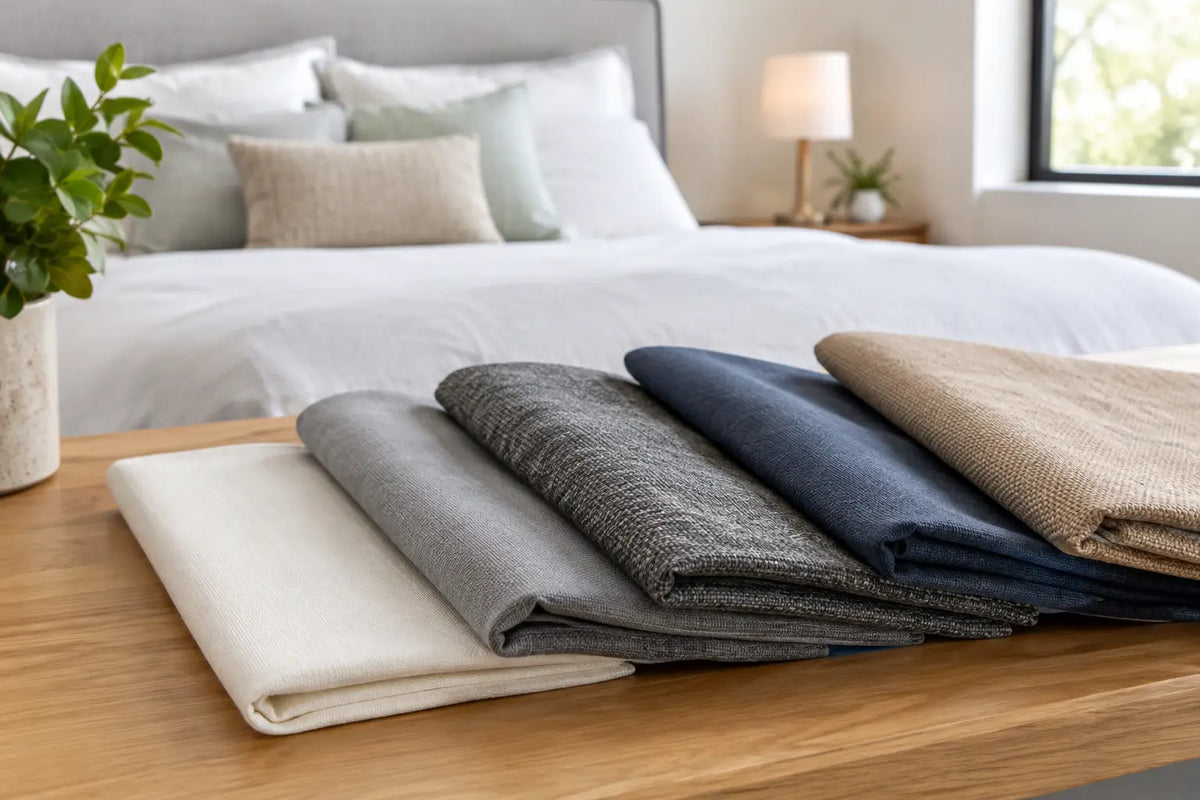
A fabric bed should feel as considered in year eight as it did on the day it arrived. If you are asking which bed fabric lasts longest, the most dependable answer is a tightly woven performance fabric or high-quality wool blend. Yet longevity is not simply a question of fibre. The weave, pile, colour, placement of the bed and the way it is cared for all play a part in how beautifully your upholstery matures.
For a bedroom intended to be a lasting retreat rather than a short-term design choice, it pays to look beyond the swatch’s first impression. The right fabric brings softness and visual depth to an upholstered bed, while quietly standing up to daily life.
Which bed fabric lasts longest in a real bedroom?
For most households, performance velvet, tightly woven polyester upholstery and wool-blend fabrics offer the strongest combination of durability, appearance and everyday practicality.
Performance fabrics are designed with regular use in mind. They tend to resist abrasion, staining and fading more effectively than delicate natural fibres, making them a particularly reassuring choice for busy family homes, pet owners or rooms that receive strong daylight. A high-quality polyester or polyester-blend weave can hold its shape exceptionally well and is usually straightforward to maintain.
Wool blends are equally compelling for a more tailored, naturally luxurious finish. Wool has a degree of natural resilience: its fibres spring back after pressure, helping the upholstery retain a composed appearance around a headboard, side rails and footboard. Pure wool can be more specialist in its care requirements, so a blend often provides the most practical route to a refined, enduring bed.
The best choice depends on how the room is used. A rarely used guest bedroom allows more freedom to select a delicate linen or boucle. A principal bedroom, a children’s room or a hotel setting benefits from a fabric selected for performance first, then colour and texture.
Durability begins with the weave, not just the fibre
It is tempting to rank upholstery simply as velvet, linen, cotton or wool. In practice, two fabrics made from the same fibre can perform very differently. A loose open weave is more vulnerable to snagging and stretching than a dense, closely constructed fabric. A short, tightly packed pile will generally remain neater than a long, relaxed pile.
When considering fabric swatches, look closely at the surface. Does it feel substantial rather than flimsy? Is the weave even and closely finished? Does the fabric recover when gently pressed between your fingers? These small details offer a more useful indication of daily performance than a fabric name alone.
For upholstered beds, the fabric also needs to work across broad, structured panels. A headboard is regularly leaned against, while an ottoman base may be touched, opened and closed frequently. Fabrics with good dimensional stability are less likely to appear slack or distorted over time.
Understanding abrasion ratings
Abrasion testing, often expressed as a Martindale score, measures how well a fabric withstands rubbing. It is a useful reference point, though it should never be the only deciding factor.
For a bed in a lightly used room, a moderate rating can be entirely suitable. For a bed used every night, look for upholstery specified for domestic use with a stronger abrasion performance. Contract-grade fabrics are designed for more intensive settings and can be an excellent consideration for hospitality projects or exceptionally busy homes.
A higher figure does not automatically mean a lovelier fabric, nor does it guarantee that every aspect of the upholstery will be maintenance-free. It simply provides helpful reassurance that the surface has been tested for repeated friction.
How the most popular bed fabrics compare
Performance velvet: luxurious and practical
Modern performance velvet is often the leading choice for clients who want an opulent bedroom without excessive fragility. Unlike traditional velvet, which can be sensitive to marks and pressure, performance versions are usually made with durable synthetic fibres and a dense, short pile.
It gives a bed graceful light-catching depth, particularly in rich neutrals, deep blue, forest green or warm stone tones. It can show shading when brushed in different directions, but this is part of velvet’s character rather than a fault. Choose a quality performance velvet and attend to spills promptly, and it can remain handsome for many years.
Wool blends: naturally resilient and quietly refined
A wool-blend fabric has a warmth and texture that suits both classic and contemporary bedrooms. Its natural bounce makes it especially good at resisting the flattened appearance that can develop where a headboard is used every evening.
Wool is more susceptible to moths if neglected, so regular vacuuming with a soft upholstery attachment is wise. It can also be less forgiving of spills than performance fabric. Nevertheless, for a beautifully tailored look with impressive longevity, a well-made wool blend is difficult to surpass.
Polyester and woven blends: the practical long-term choice
Tightly woven polyester and mixed-fibre fabrics are often underestimated because they are so practical. They are colourfast, hardwearing and available in an extensive range of textures, from smooth contemporary weaves to soft linen-look finishes.
This category is especially suitable for ottoman beds, children’s beds and rooms where ease of care matters. The key is to avoid very thin or loosely woven options. A substantial upholstery-grade weave will look more polished and last considerably longer.
Linen and cotton: beautiful, but best chosen with care
Linen and cotton bring an effortless, natural character to a bedroom. They are breathable and tactile, and their relaxed texture can be immensely appealing in a calm, layered scheme.
However, they are usually less resistant to staining, creasing and abrasion than synthetic performance fabrics or wool blends. Linen may soften and develop a lived-in appearance, which some people adore. If you prefer your bed to retain a crisp, immaculate finish, it is better suited to a low-traffic guest room or as part of a blend that improves resilience.
Boucle and heavily textured fabrics: consider the setting
Boucle has an inviting, design-led appeal, creating a wonderfully cocooning headboard. Its loops and raised texture, however, can catch on jewellery, pet claws or sharp edges. It can last well in a carefully used room, but it is not usually the first recommendation for a household seeking the lowest-maintenance option.
The same principle applies to open-weave fabrics and elaborate textures. They may be the perfect finishing touch in the right setting, but their beauty comes with a little more responsibility.
Colour and placement affect how fabric ages
Fabric durability is not only about whether it wears through. It is also about whether it continues to look fresh. Very pale upholstery can show transfer from dark clothing, cosmetics or daily handling more readily than mid-tones. Very dark fabrics can reveal dust, particularly velvet and flat weaves.
Mid-toned shades such as mushroom, taupe, warm grey, olive and soft mineral blue are often the most forgiving while still feeling elevated. If the bed sits beside a sunny window, ask about colourfastness and consider curtains or blinds that protect the room during the brightest part of the day. Persistent direct sunlight can fade almost any fabric over time.
A tall headboard may also receive more contact than the base itself. If you enjoy reading in bed, select a resilient fabric for the headboard even if the rest of the room is gently used.
Simple care that protects an upholstered bed
No fabric is entirely maintenance-free, but a few considered habits make an appreciable difference. Vacuum the bed lightly every few weeks using a clean, soft brush attachment to remove dust before it settles into the weave. Address spills immediately by blotting, never rubbing, with a clean absorbent cloth.
Avoid placing an upholstered bed directly against a radiator, and leave sufficient room for airflow around the frame. When moving the bed, lift it rather than dragging the upholstered sections across flooring or door frames. For deeper marks, use the care guidance supplied for the specific fabric, or arrange professional upholstery cleaning where appropriate.
Choose the fabric that suits your life, not only your mood board
The longest-lasting bed fabric is usually a tightly woven performance upholstery or a quality wool blend, selected with the room’s use in mind. Performance velvet offers a particularly persuasive balance of glamour and resilience, while woven polyester blends provide calm confidence for active households.
At Hyder Living, complimentary fabric swatches allow you to see a colour and feel a texture in your own light before making a decision. Take the swatch to the bedroom, view it in morning and evening light, and consider how you truly use the space. The most luxurious choice is the one that continues to offer comfort, composure and pleasure long after the bedroom is complete.
Share:
Divan Versus Platform Bed: Which Feels Right?