
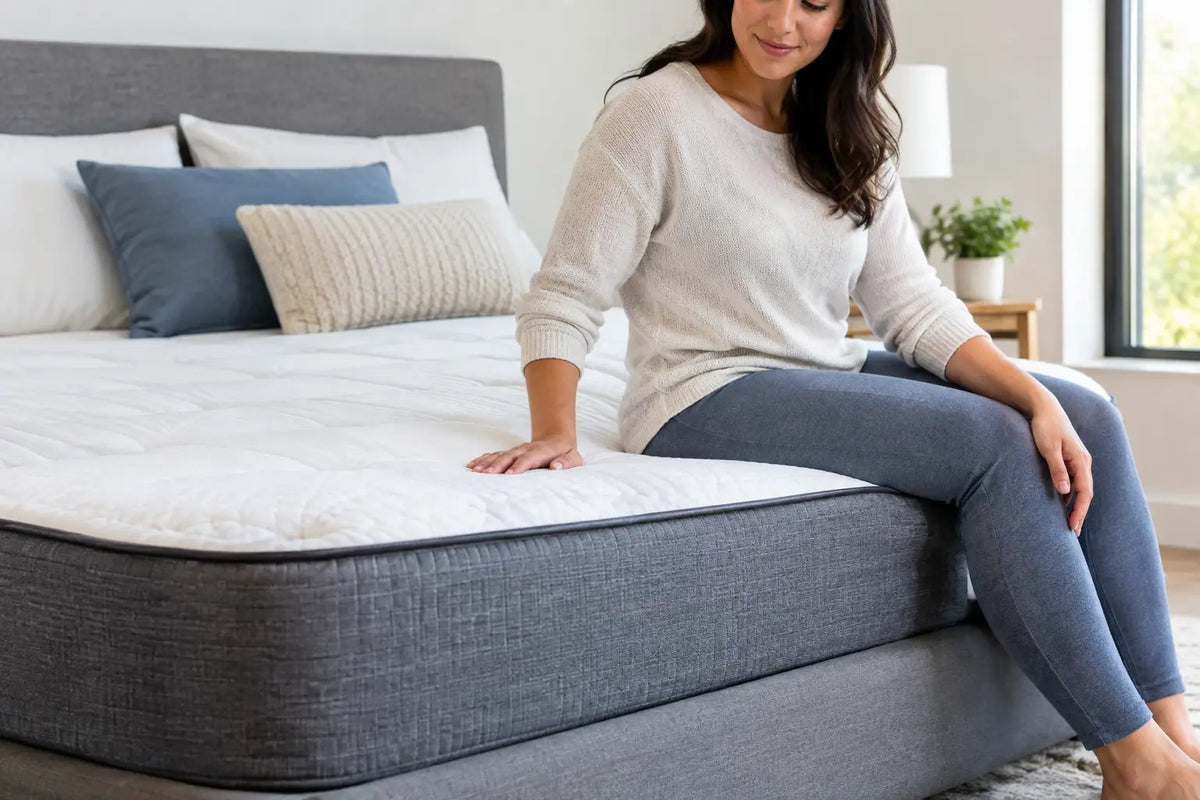
The difference is often felt in the first few minutes of ownership. You sit on the side of the bed to put on your slippers, settle beside your partner, or move towards the edge during the night, and the mattress holds its poise rather than dipping away beneath you. Quality mattress edge support is not a showy feature, but it has a marked effect on how spacious, secure and luxurious a bed feels every day.
For a considered bedroom, the mattress should work in harmony with the bed frame, divan or ottoman base beneath it. The right edge construction helps preserve the composed appearance of the sleep surface while giving you more practical room to rest, read and rise with ease.
What is mattress edge support?
Mattress edge support is the reinforcement built around the perimeter of a mattress. Its purpose is to reduce compression at the sides, helping the mattress maintain a more even sleeping surface from the centre to the edge.
Without sufficient reinforcement, the outer few inches can feel noticeably softer than the middle. This is particularly apparent when sitting on the bed or when two people share a mattress and naturally spread out. A supportive perimeter does not mean the edge should feel hard or rigid. In a well-made mattress, it should feel stable yet comfortably integrated with the rest of the sleep surface.
The most common forms of edge support are a reinforced spring border, higher-tension springs around the perimeter, and foam encapsulation. Each approach can be highly effective when it is properly matched to the mattress’s spring system, fillings and intended comfort level.
Why mattress edge support matters in a refined bedroom
A generous bed is one of life’s most worthwhile comforts, but even a super king can feel less accommodating if its edges collapse under normal use. Strong mattress edge support gives you access to a greater proportion of the mattress surface, which matters for couples, families enjoying a slow weekend morning, and anyone who prefers room to change position overnight.
It also improves confidence when getting in and out of bed. Those recovering from an injury, people with reduced mobility, and anyone who simply dislikes the feeling of sliding downwards when seated will appreciate a steadier edge. The benefit is subtle, but it contributes to the sense that your bed has been specified with care rather than selected as an afterthought.
There is an aesthetic consideration too. A mattress that retains its shape presents better on an upholstered bed or tailored divan base. The sides remain neater, the sleeping surface looks more inviting, and the overall arrangement has the polished finish expected of a beautifully furnished bedroom.
It is especially valuable for couples
Partners rarely occupy a bed with perfect symmetry. One person may sleep close to the edge, while the other enjoys a broad central space. A firmer perimeter reduces that precarious, rolled-off sensation and can make sharing a standard king size feel more relaxed.
That said, edge support is only one part of motion management. If one partner is a light sleeper, individually responsive pocket springs are often equally significant. They react more locally than interconnected springs, so movement on one side is less likely to travel across the mattress.
It makes the most of larger mattress sizes
An emperor mattress offers a glorious amount of room, but its size alone does not guarantee useful space. The perimeter still needs to support the body comfortably. Conversely, a well-constructed king size with dependable edges can feel surprisingly generous and may be the more sensible choice where a bedroom has tight walkways or a statement headboard.
How different mattress constructions support the edges
The specification beneath the fabric matters far more than an impressive-looking border. When comparing mattresses, ask how the edge is constructed and how that construction relates to the mattress as a whole.
Pocket springs with reinforced borders
A pocket-sprung mattress contains individual springs housed in separate fabric pockets. This enables the mattress to respond to weight with greater precision, supporting different sleeping positions and reducing partner disturbance.
On premium models, the perimeter may use firmer springs or a strengthened spring border. This creates a supportive boundary while retaining the responsive, breathable character that makes pocket springs so popular. For those seeking a traditional, naturally comfortable feel, this construction pairs beautifully with layers such as wool, cotton, cashmere or breathable recycled fibres.
The quality varies considerably. Spring count can be useful context, but it is not a complete measure of comfort or durability. The spring gauge, distribution, tension, upholstery layers and the skill of the mattress build all influence the final result.
Foam-encapsulated edges
Foam encapsulation uses a dense foam frame around the spring unit. It can provide a very stable edge and creates an impressively level surface across the mattress. This is particularly attractive for sleepers who sit on the side of the bed regularly or want the fullest possible use of the mattress width.
The trade-off is feel. Some people enjoy the more structured sensation, while others prefer the softer, traditionally upholstered character of a sprung border. Foam quality is important here: a poorly specified foam frame may fatigue over time, whereas a high-density, thoughtfully engineered perimeter should offer enduring support.
Open-coil mattresses
An open-coil mattress uses interconnected springs and is typically a more economical option. It can offer adequate support for occasional use, guest rooms or certain children’s beds, but its edges are usually less individually responsive than those of a pocket-sprung design.
This does not make an open-coil mattress unsuitable. It simply means expectations should be aligned with how frequently it will be used and who will sleep on it. For a principal bedroom where restorative sleep and a tailored finish are priorities, a more refined spring system is often worth considering.
A firm edge is not the same as a firm mattress
This distinction is essential. Mattress firmness describes how the whole sleep surface feels beneath your body. Edge support concerns the stability of its outer perimeter. You can choose a plush, medium or firmer mattress with excellent edge construction.
A side sleeper may favour a medium mattress with generous pressure relief at the shoulders and hips, yet still benefit from a well-supported edge. A back or front sleeper may prefer a firmer feel to help maintain a comfortable spinal position. Body weight, sleep position, personal preference and the type of fillings all play a part, so there is no universal “best” firmness.
When testing a mattress, do more than press your hand into the centre. Sit naturally on the side as you would each morning, then lie close to the edge for a few moments. Notice whether you feel supported without being pushed back towards the middle. If possible, test it with your usual pillow height in mind, as your complete sleep set-up influences comfort.
Choosing the right edge support for your home
Start with the way the bed will be used. A couple sharing a king or super king, a household that enjoys breakfast in bed, or someone who sits to dress each day may place greater value on a reinforced perimeter. In a guest bedroom, the priority may instead be a balanced medium feel that suits a range of visitors.
Consider the base as well. A mattress needs a properly supportive foundation to perform as intended. A sprung divan base can add a little responsive give, while a solid platform base delivers a firmer underlying feel. With slatted bed frames, check that the slats are sound, evenly spaced and appropriate for the mattress type. An unsupportive base can compromise comfort and contribute to premature wear, even where the mattress itself has strong edges.
For ottoman storage beds, ensure the mattress weight is appropriate for the lifting mechanism and that it sits neatly within the frame. A well-proportioned mattress and base make daily access to storage feel effortless, while preserving the elegant silhouette of the bed.
Care that protects the mattress perimeter
Regular rotation helps distribute wear, particularly on mattresses designed to be single-sided. If your mattress is dual-sided, follow the maker’s instructions for turning as well as rotating it. Handles, where fitted, are for positioning rather than carrying the full mattress weight.
Use a breathable mattress protector to guard against spills and everyday moisture without trapping unnecessary heat. Avoid persistently sitting in precisely the same spot, especially on one edge, and never fold or bend the mattress when moving it. These small habits are especially worthwhile in a principal bedroom, where the mattress is used night after night.
A luxurious bed should invite you to use every inch of it, from a quiet moment at the edge in the morning to the restorative sleep that follows. Choose a mattress whose perimeter feels as considered as its comfort layers, and your bedroom will offer the composed, welcoming ease of a five-star retreat for years to come.
Share:
Is Super King Sizing Right for Your Bedroom?
Best Mattress Materials Explained for Better Sleep