
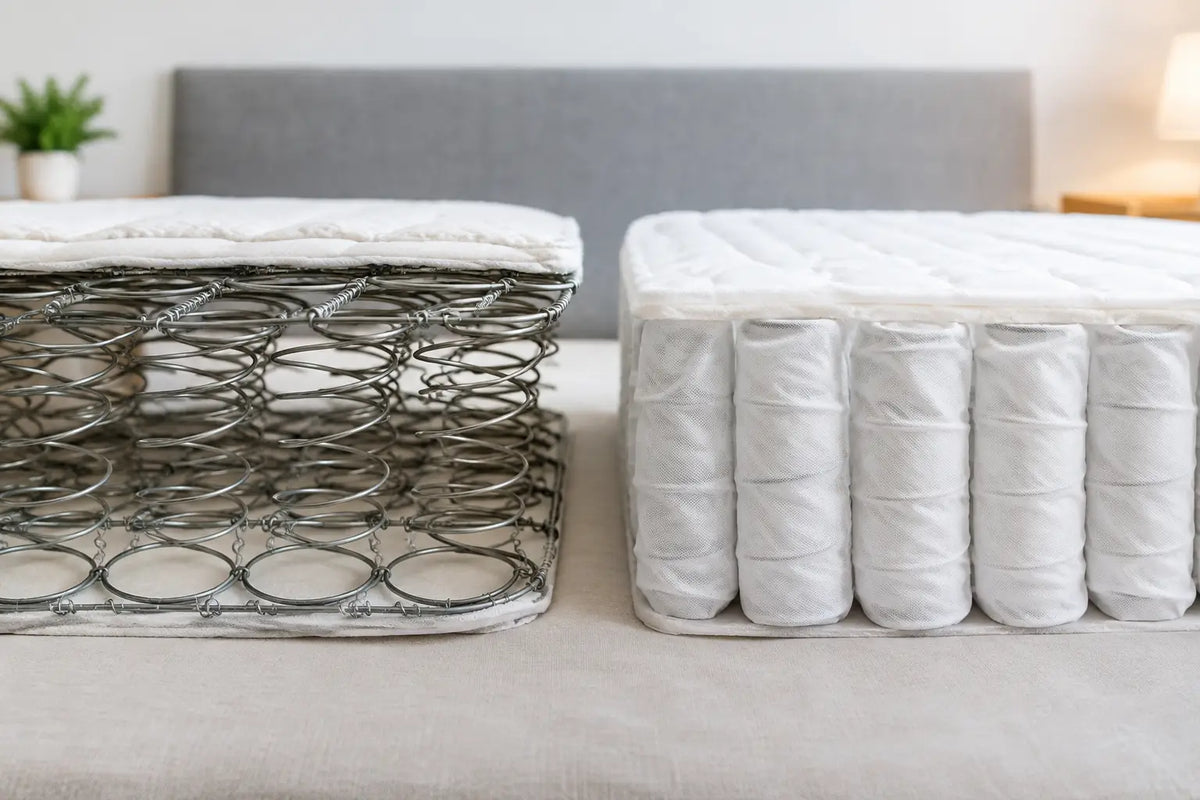
A mattress can look beautifully tailored on a statement bed, yet the part that determines how you wake is hidden beneath the ticking. When choosing between open coil versus pocket springs, the real question is not which is universally better. It is which construction suits your body, preferred sleep position, bedroom and expectations of comfort over time.
Open coil and pocket sprung mattresses can both provide dependable support. Their difference lies in how the springs move, how precisely they respond to weight, and how refined the mattress feels when sharing a bed. For a guest room or occasional use, one may be entirely appropriate. For a principal bedroom designed around deeply restorative sleep, the other is often worth considering more closely.
Open Coil Versus Pocket Springs at a Glance
An open coil mattress, sometimes called a traditional or Bonnell spring mattress, uses a network of hourglass-shaped metal springs joined together by a wire framework. When weight is placed on one area, the interconnected system responds as a whole. It is a familiar, straightforward construction that has remained popular because it offers firm, even support at an accessible price point.
A pocket sprung mattress contains individual springs housed in their own fabric pockets. Each spring can compress independently, responding to the contours and pressure points of the sleeper above it. This creates a more tailored sensation, particularly around the shoulders, hips and lower back.
Neither design is automatically soft or firm. The final feel comes from a combination of spring tension, the comfort layers above the springs, the mattress depth, and materials such as wool, cotton, memory foam, latex or recycled fibres. Still, the spring unit creates the essential character of the mattress.
How an Open Coil Mattress Feels
Open coil mattresses tend to offer a firmer, more level sleeping surface. Because the springs are connected, pressure is spread across a broader area rather than being absorbed precisely where it is applied. Some people enjoy this supportive, traditional feel, especially those who prefer not to sink into a mattress.
They are usually lighter to turn and move than more substantial pocket sprung models, which can be useful in a spare bedroom, children’s room or a property where a mattress may need to be repositioned regularly. Their simpler construction also makes them a sensible choice when setting a clear budget for a guest bed or furnished rental.
The compromise is in responsiveness. If one partner turns during the night, movement can travel through the interconnected spring system. This may be of little concern for a single sleeper, lighter sleeper, or a bed used occasionally. Couples with different schedules, however, may notice more disturbance than they would with individually moving springs.
Open coil mattresses can also feel less contouring around prominent pressure points. A well-designed comfort layer can improve this considerably, but the underlying support will remain broad rather than highly localised.
Who is an open coil mattress best for?
An open coil design can work very well for children, guest rooms, occasional sleeping arrangements and buyers who favour a supportive, uncomplicated feel. It can also be a practical option where mattress weight matters. The key is to choose sufficient depth and quality upholstery for the intended level of use, rather than judging a mattress solely by its spring type.
Why Pocket Springs Feel More Personalised
Pocket springs work independently, allowing the mattress to adapt more closely to the body. When your shoulder settles into the bed as a side sleeper, the springs beneath it can compress without requiring the rest of the mattress to move in exactly the same way. The result is often a more balanced, gently cradling feel while retaining support.
This independent action is especially valuable for couples. A partner getting in or out of bed, changing position, or rising early is less likely to create movement across the entire sleep surface. It is not complete motion isolation in the way some specialist foam mattresses may provide, but it is a marked improvement over a conventional linked coil unit.
Pocket sprung mattresses also offer greater scope for nuanced comfort. Manufacturers can vary spring tensions across the mattress, creating zones that provide firmer support through the lumbar region and more give around the shoulders. This is particularly appealing for sleepers who want their bedroom to feel considered in every detail, from the upholstered headboard to the quality of their nightly rest.
A pocket sprung mattress is generally heavier and often more substantial. That sense of weight can reflect generous fillings and a more complex construction, although it also means rotation is best done with two people. Turning handles are useful for this purpose, but they should assist rather than bear the full load of lifting.
Spring Count Is Not the Whole Story
A higher pocket spring count can indicate a more responsive sleep surface, but it should never be treated as a shortcut to quality. Spring count may refer to the full mattress, not each side, and manufacturers can use smaller springs in comfort layers to create an impressive figure. Those springs may contribute to feel, but they are not directly comparable with the larger springs in the main support unit.
Look beyond the number. Consider the spring tension, mattress depth, type and amount of upholstery, edge support, whether the mattress is single or double sided, and the quality of the cover. Natural fillings such as wool can help regulate temperature and manage moisture, while cotton adds breathable softness. A carefully upholstered mattress with a moderate spring count may provide more enduring comfort than one marketed primarily around a large number.
For two sleepers, it is also worth considering the size of the bed. A king size gives noticeably more personal space than a double, while a super king can transform shared sleep for those with the room to accommodate it. The most sophisticated mattress cannot fully compensate for a sleep surface that is too narrow for two people to rest comfortably.
Choosing Support for Your Sleep Position
Your usual sleeping position should guide the decision more than any trend. Back sleepers often appreciate medium-firm to firm support that keeps the spine comfortably aligned. Both open coil and pocket springs can provide this, though a pocket sprung design may feel more accommodating at the lower back and shoulders.
Side sleepers commonly benefit from greater pressure relief at the shoulder and hip. A pocket sprung mattress with well-chosen comfort layers is often the more natural choice here, as it can contour without allowing the body to sink excessively. A very firm open coil mattress may feel too unyielding unless softened by generous upholstery or a quality topper.
Front sleepers typically need a flatter, more stable surface to avoid the hips dipping too deeply. This can make a firmer open coil or firm pocket sprung mattress suitable, depending on body weight and personal preference. If possible, spend time lying in your normal sleeping position rather than sitting on the mattress edge and making a decision in moments.
The Bed Base Matters Too
A mattress does not work in isolation. A well-built divan base provides an even foundation and is often designed to complement the mattress placed upon it. Slatted bed frames can also offer excellent support, provided the slats are secure, sufficiently close together and appropriate for the mattress warranty requirements.
For an upholstered ottoman or storage bed, check that the mattress weight is suitable for the lifting mechanism. Pocket sprung mattresses with deep natural fillings can be considerably heavier than open coil alternatives. This need not rule them out, but it is worth accounting for when choosing a practical, elegant storage solution for everyday use.
Good airflow beneath the mattress matters whichever spring system you choose. Allowing the bed to breathe helps manage moisture and keeps the sleep environment fresher. A mattress protector can add a valuable layer of day-to-day care without replacing the need for regular airing and rotation.
Value, Longevity and the Right Level of Luxury
Open coil mattresses are usually less expensive, making them a good-value choice where the bed is not used every night. Their accessible price does not make them inferior by default. A thoughtfully made open coil mattress may be exactly right for a guest bedroom that deserves comfort without unnecessary expense.
For nightly use, especially in a shared bed, pocket springs often justify their higher cost through more individualised support, reduced partner disturbance and greater potential for layered comfort. The long-term value comes from choosing a mattress that continues to feel supportive rather than simply choosing the most luxurious specification on paper.
At Hyder Living, the most successful bedroom schemes begin with how you want the room to feel when the day is over: calm, beautifully composed and entirely your own. Choose the spring system that supports that feeling, then give it the care it deserves through regular rotation, a suitable base and a little room to breathe.
Share:
Bedroom Upholstery Colours That Feel Timeless
Can Upholstered Beds Suit Allergies at Home?