
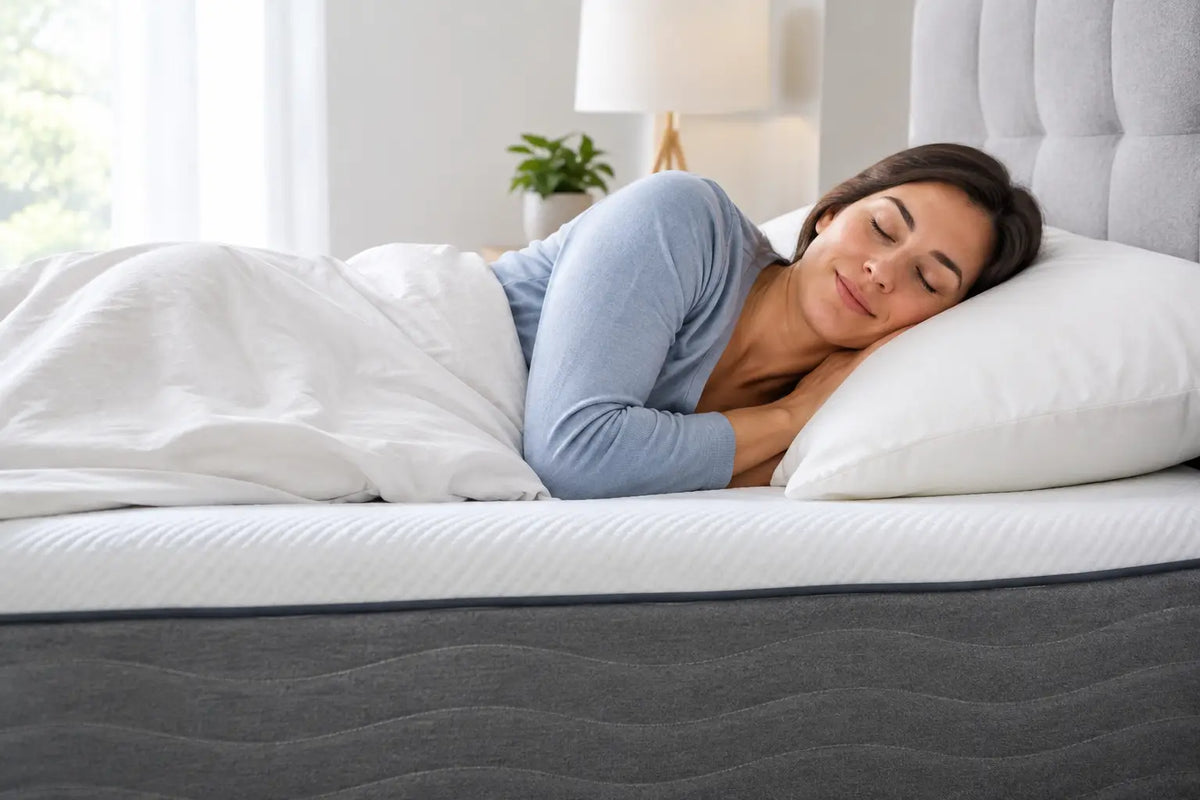
Your shoulder should not be the price you pay for sleeping in your favourite position. For the many people who settle on their side each night, the question of which mattress suits side sleepers comes down to a careful balance: enough cushioning to relieve pressure at the shoulder and hip, with enough underlying support to keep the spine comfortably aligned.
A mattress that feels sumptuously soft for five minutes in a showroom can be quite different after eight hours. Equally, a very firm mattress may appear reassuringly supportive yet leave a side sleeper waking with a numb arm, tender hip or stiffness through the lower back. The most rewarding choice is one that lets your body settle naturally while maintaining the poised, supported feeling associated with truly restorative sleep.
Which mattress suits side sleepers best?
Most side sleepers are best served by a medium to medium-firm mattress with a pressure-relieving comfort layer. This level of comfort allows the shoulder and hip to sink in slightly, rather than being held on top of an unyielding surface, while the core of the mattress supports the waist and lower back.
That said, firmness is personal. A lighter person may find a medium mattress sufficiently cushioning, while a larger or broader-framed sleeper may prefer medium-firm support with a deeper comfort layer. Your preferred feel, body shape, whether you sleep alone, and the condition of your current mattress all influence the right decision.
Rather than choosing only by a firmness label, consider how a mattress responds to the three key contact areas of side sleeping: the shoulder, ribcage and hip. The shoulder needs room to settle without compressing excessively. The hip needs gentle contouring so it is not pushed upwards. Meanwhile, the middle of the body must be supported so the spine remains level, rather than bowing down towards the mattress.
Pressure relief matters as much as support
When you sleep on your side, your weight is concentrated across a narrower area than it is when sleeping on your back. This makes pressure relief particularly valuable. Without it, the shoulder bears too much force and circulation can be restricted, leading to the familiar urge to turn over repeatedly during the night.
Memory foam, latex, natural wool and generously upholstered fibre layers can all provide welcome comfort, though they do so in different ways. Memory foam slowly moulds to the body, creating a close, cocooning feel. It is particularly helpful for sleepers who enjoy noticeable contouring, but some people find traditional foam warmer or less responsive when changing position.
Latex has a more buoyant character. It cushions pressure points while gently springing back into shape, making it an excellent consideration for combination sleepers who begin on their side but move during the night. Quality latex can also offer good breathability and durability.
Natural wool offers a beautifully refined alternative for those who appreciate a more traditionally upholstered sleep surface. Wool helps regulate temperature, absorbs moisture and creates soft, resilient comfort without the close hug of memory foam. It can be particularly appealing in a handcrafted mattress with layered fillings and a breathable cotton cover.
Choose a supportive core beneath the comfort layers
Comfort layers alone do not make a suitable side-sleeper mattress. The support system beneath them is what helps preserve alignment through the night and over the years of ownership.
Pocket springs are a strong choice for couples and side sleepers alike. Each spring works independently, allowing the mattress to respond more precisely to the body than a connected spring unit. The result is targeted support around the hip and waist, alongside reduced movement transfer when your partner turns or rises earlier.
A higher spring count can indicate a more finely responsive mattress, although it should never be viewed in isolation. Spring gauge, the quality of the upholstery, the depth of the mattress and the overall construction all matter. A thoughtfully made mattress with fewer, well-engineered pocket springs and generous natural fillings may feel far more luxurious than one that relies on a headline number alone.
Hybrid mattresses combine pocket springs with foam, latex or fibre comfort layers. For many side sleepers, this is an appealing middle ground: the stable, breathable support of springs with the pressure-relieving qualities of a modern comfort layer. A hybrid can also be an excellent option where one partner prefers a slightly softer surface and the other needs steadier support.
Medium or medium-firm: how to decide
A medium mattress is often ideal if you are lighter in build, have prominent shoulders or hips, or prefer a gentler, more enveloping feel. It gives those pressure points more opportunity to settle. If you wake with a sore shoulder on a firm mattress, moving towards medium comfort may make a meaningful difference.
Medium-firm tends to suit those of average to larger build, sleepers who experience lower-back discomfort, or anyone who likes the security of a more supportive surface without sacrificing comfort. The best medium-firm mattresses still have enough depth in their upholstery to prevent the shoulder feeling perched or compressed.
Very firm mattresses can work for a small number of side sleepers, especially those with a higher body weight who require a more substantial core. But firmness without adequate cushioning is rarely a gracious choice for this position. If you prefer a firmer mattress, look for one with a deep pillow top, wool-rich upholstery or a responsive latex layer to soften the initial contact points.
Your pillow changes the equation
A beautiful mattress cannot fully compensate for a pillow that is too low or too high. On your side, your pillow should fill the space between the mattress and the side of your head, keeping your neck in line with the rest of your spine.
A deeper mattress may require a slightly loftier pillow, particularly for people with broader shoulders. Conversely, an excessively high pillow can tilt the neck upwards and create tension even on the most carefully chosen mattress. Consider the two as a sleep system, especially if you are replacing both at once.
Temperature and movement are worth considering
Side sleepers often curl slightly, increasing contact with the mattress and making heat retention more noticeable. If you tend to sleep warm, prioritise breathable materials such as wool, cotton, open-cell foam, latex and pocket-spring constructions with good airflow. A mattress protector should also be breathable, as an impermeable layer can undermine the cooling qualities of the mattress beneath.
If you share a bed, motion isolation is equally useful. Pocket springs and quality foam layers can reduce the sensation of a partner moving during the night. This is especially welcome on king size, super king and emperor beds, where a generous sleeping space deserves a mattress that allows each person to rest undisturbed.
Test for alignment, not just initial softness
When trying a mattress, lie on your side for longer than a few moments. Settle into your usual position, with the pillow you would normally use if possible. Notice whether your shoulder relaxes, whether your hip feels cushioned, and whether there is a sense of strain through your waist or lower back.
The right mattress should feel inviting without allowing you to sink so deeply that turning becomes difficult. Your spine should appear broadly straight from neck to tailbone when viewed from behind. If your shoulder feels compressed, the surface may be too firm. If your hips dip lower than your shoulders or you feel folded through the middle, it may be too soft.
For a considered bedroom scheme, the mattress should also be proportionate to the bed frame and your lifestyle. A deep, luxurious mattress can look exceptional with an upholstered headboard and elevate the whole room, but check that its finished height allows you to sit comfortably and makes changing bedding manageable. If you choose an ottoman storage bed, remember that a heavier mattress may require more care when lifting the base, even with assisted opening mechanisms.
Do not overlook long-term care
A premium mattress should retain its comfort with appropriate care. Follow the manufacturer’s guidance on rotation or turning, as this differs between single-sided and dual-sided designs. Rotating distributes wear more evenly, while turning a double-sided mattress allows both sleep surfaces to be enjoyed over its lifespan.
Use a well-fitting mattress protector to guard against spills and everyday moisture, but choose one that does not compromise breathability. A supportive bed base is also essential. Even a beautifully constructed mattress cannot perform as intended on damaged slats, an uneven frame or an unsupportive foundation.
The most luxurious answer is not necessarily the softest mattress in the room. It is the one that welcomes your shoulder, steadies your hips and lets you wake feeling as though the night has genuinely restored you. Taking time to match materials, firmness and construction to your own body is an investment in the kind of quiet comfort that makes a bedroom feel like a private five-star retreat.
Share:
Bespoke Furniture for a Bedroom That Fits You
Is Super King Sizing Right for Your Bedroom?